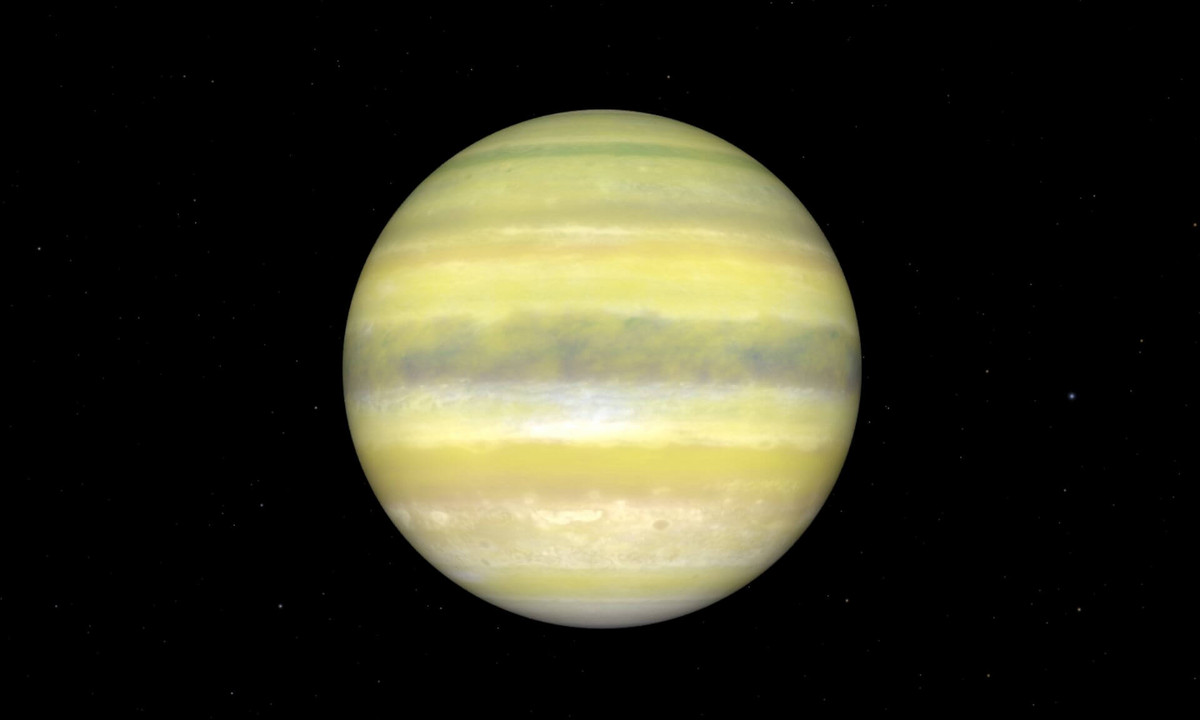
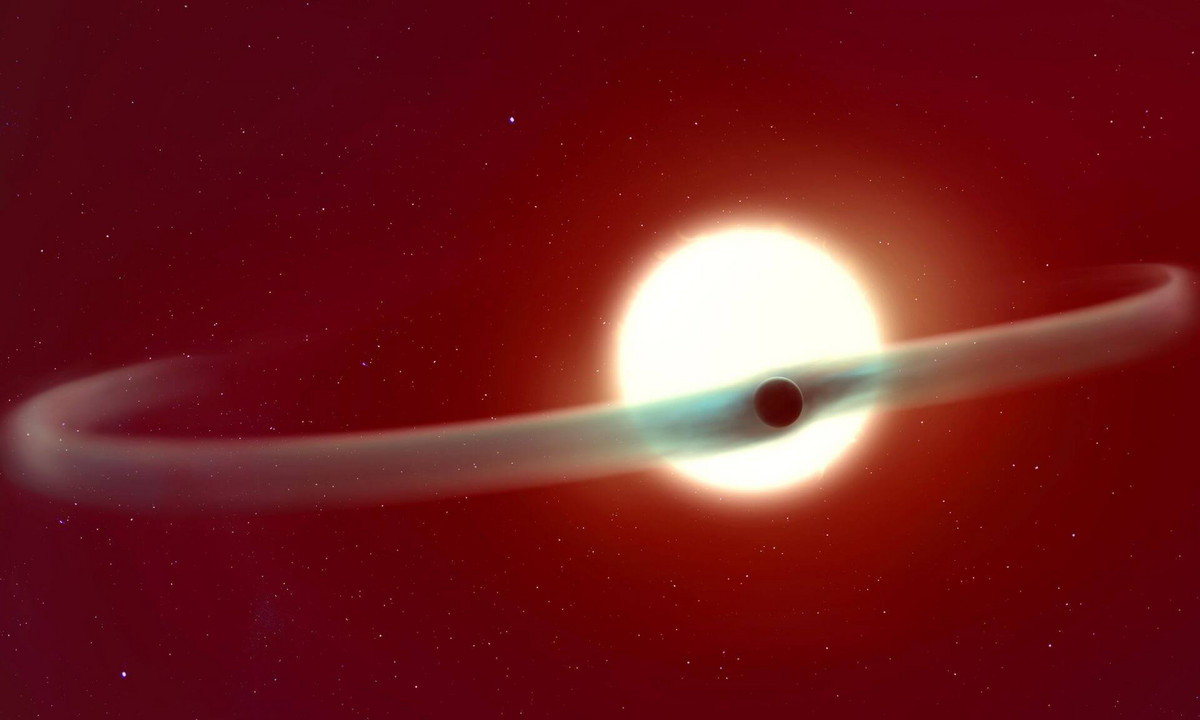
What sets GJ 9827 d apart is its atmosphere's composition.
By combining JWST/NIRISS and HST data, Piaulet-Ghorayeb showed that, unlike the hydrogen-dominated atmospheres of larger planets, GJ 9827 d’s is rich in heavier molecules, with quite a bit of water vapour.
This discovery marks the first robust detection of an exoplanet atmosphere where hydrogen is not the dominant component, suggesting instead a heavier, water-rich atmosphere.
“It’s closer in molecular weight to the carbon dioxide or nitrogen-rich atmospheres that we are currently looking for on smaller rocky planets, where we would eventually look for life,” said Piaulet-Ghorayeb.
She and her team made their observations via the Canadian instrument on JWST, the Near-Infrared Imager and Slitless Spectrograph (NIRISS). Using transmission spectroscopy, they analysed the star light passing through the planet’s atmosphere as it transited (passed in front of) its host star, GJ 9827.
They then combined the new JWST observations with previous HST observations to confidently show that the observed spectral features are caused by the planet’s atmosphere and not by contamination from the system’s star.
With the data from JWST/NIRISS SOSS, scientists can finally distinguish between two types of atmospheres for the planet: one is cloudy with few heavier elements, mainly hydrogen with water only present in trace amounts; the other has a high density with many heavier elements and a lot of water.
Because GJ 9827 d is close to its star, its atmosphere is likely a mix of gas and a superheated, dense state, rather than having distinct layers or clouds.