40 light-years away

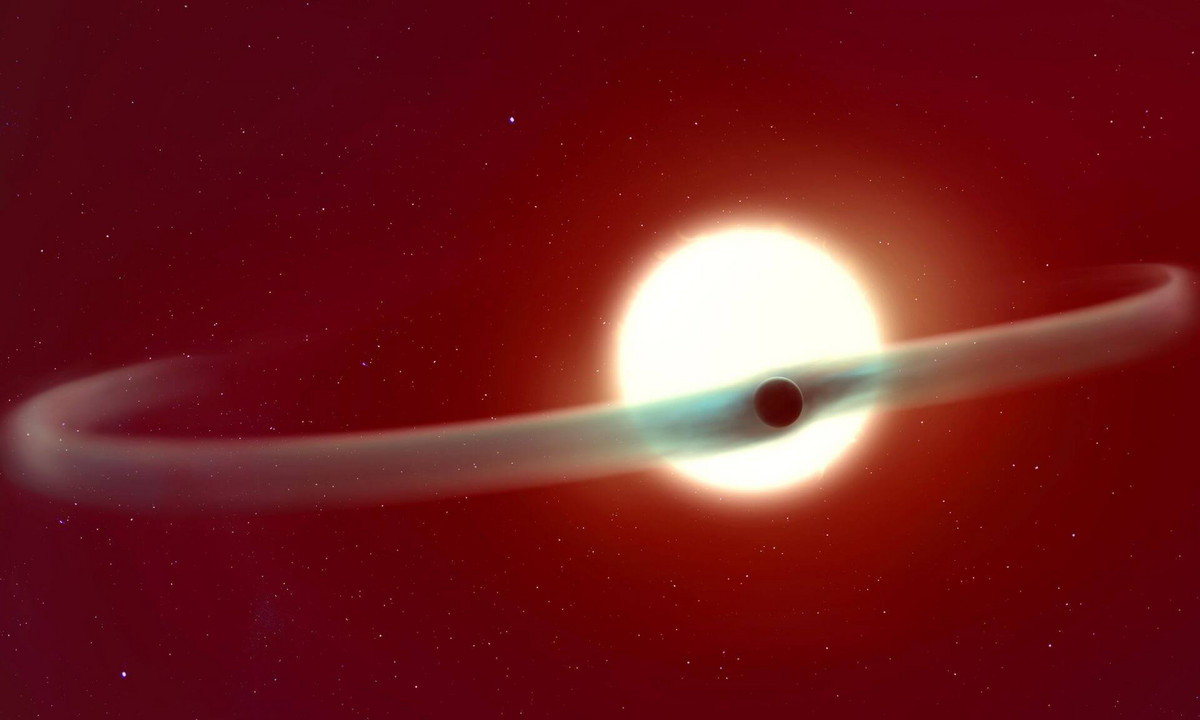
The TRAPPIST-1 planetary system, a red dwarf star located 40 light-years from Earth, was unveiled in 2017. It holds the record for the largest number of Earth-sized rocky planets known to orbit a single star: seven in total.
TRAPPIST-1 is much dimmer and cooler than our sun. As a result, its temperate zone, the region where a planet might sustain liquid water on its surface, lies much closer to the star than in our solar system.
TRAPPIST-1 d lies on the cusp of that so-called “habitable” zone, yet is only two per cent of the distance that Earth is from the sun. TRAPPIST-1 d completes an entire orbit around its star every four Earth days.
Using the Webb telescope’s Near-Infrared Spectrograph (NIRSpec), the team of astronomers did not detect key atmospheric molecules such as water vapour, methane, or carbon dioxide, gases that are abundant in Earth’s atmosphere.
The researchers also ruled out a methane-rich atmosphere on TRAPPIST-1 d that would be similar to that of the rocky world Titan, Saturn’s largest moon.
“There are a few reasons why we might not have seen signs of an atmosphere on TRAPPIST-1 d,” said Piaulet-Ghorayeb.
“The planet could have an extremely thin atmosphere, like Mars, making it very hard to detect. It might also be shrouded in thick, high-altitude clouds, like Venus, which would block the signatures of certain gases. Or, it might simply have no atmosphere at all.”