After 25 years abroad, Montrealer Patrick Charbonneau is returning to his hometown, backed by an $8-million Eddie Goldenberg Research Chair at Université de Montréal. Formerly known as the Impact+ program, the federally funded chair was created to attract exceptional researchers working abroad to Canada.
After earning a Ph.D. from Harvard University and building an international career bridging chemistry and physics, Charbonneau is excited to be back in Montreal with his family. He grew up in Ahuntsic, where his parents still live. At the Institut Courtois, his expertise – now in high demand – has found the perfect place to thrive.
Understanding and improving generative AI
A primary focus of Charbonneau’s chair will be modelling artificial intelligence through the lens of statistical physics.
“Generative AI models can work remarkably well, but we don’t truly understand why,” Charbonneau said. “For example, we don’t understand their limitations. If we can get a better grasp of how the architecture works, we’ll know when we can expect it to fail.”
Charbonneau’s method is to test AI on simple models from statistical physics, which are well understood.
“By trying to solve them using the generative approach, we can see right away if the AI makes a mistake and we can see why,” he said. “The goal is to push these tools to their absolute limits so we can improve them and use them for more complex problems.”
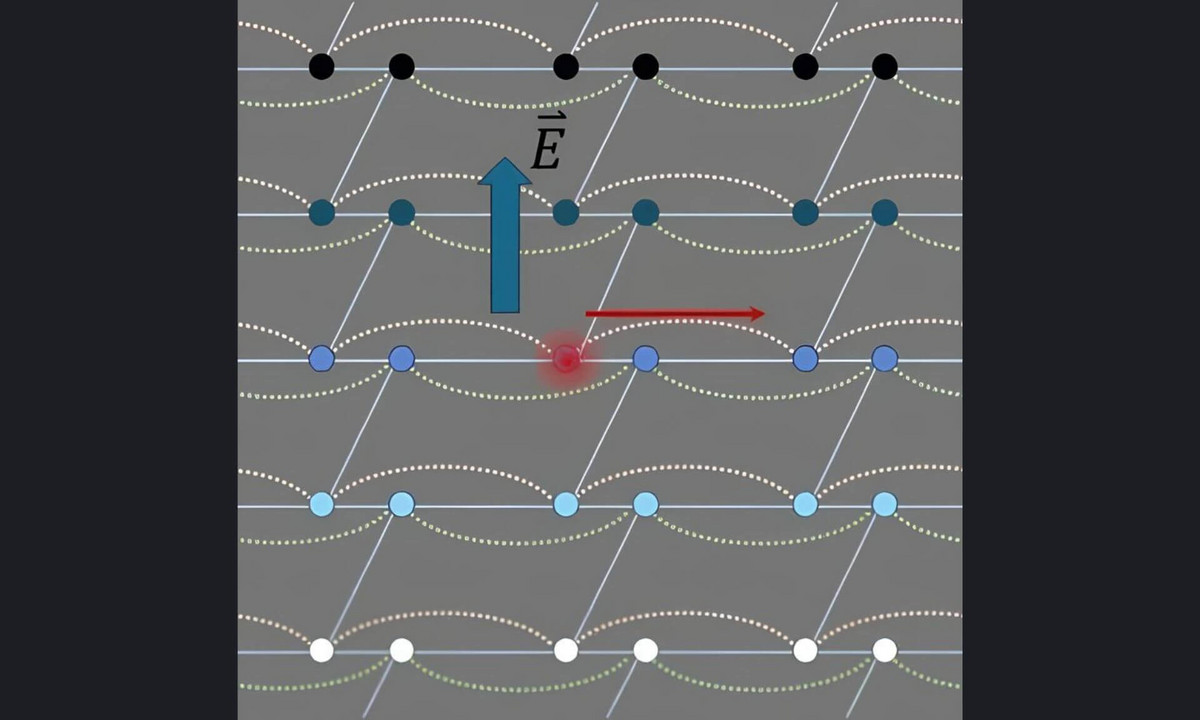
What’s the connection to materials? “In statistical physics, we don’t fully understand ‘frustrated matter,’” explained Charbonneau, who has become an expert in the field.
“Much like relationships between people, there are materials that have unfavourable interactions, and these influence, for example, the organization of matter. Understanding how these systems work is central to statistical physics, and the tools we now have to do so aren’t very effective.”
To tackle this challenge, Charbonneau plans to recruit local and international talent while building partnerships with organizations such as Mila, Samsung AI Lab Montreal and the materials industry through PRIMA Québec.
Collaboration with a Nobel laureate
Charbonneau is star in his field. In 2008, after completing a postdoctoral fellowship in Amsterdam, he joined the faculty at Duke University in Durham, North Carolina. In 2021, his research was cited twice by the Nobel committee that awarded Italian physicist Giorgio Parisi the Nobel Prize in Physics.
“Parisi has been an expert on complex systems since the late 1970s,” Charbonneau said. “He has developed analytical tools that are highly influential in various fields, including mathematics, computer science, physics and materials science.
"Parisi has often worked with physicist Francesco Zamponi, with whom I’ve been collaborating since my early years at Duke. We pooled our expertise to study glass and other disordered materials, and we developed a computational approach that quickly solved problems in glassy dynamics and the jamming transition.”
A fascination with materials
A former member of the Petits Chanteurs du Mont-Royal choir who earned a CEGEP diploma in science, humanities and arts, Charbonneau has always had broad interests. He had planned to study history until he discovered a fascination with materials. “I wanted to understand how matter was put together,” he recalled. “I found I had a knack for it and I loved science and math.”
After winning a competition organized by the Association mathématique du Québec, which allowed him to attend a summer camp where UdeM faculty members taught mini-courses, he began to envision a career as a university professor.
Having gone to English-language summer camps as a child, he chose to study at McGill University, which offered him the best merit scholarship, and graduated with an honours major in chemistry and a minor in computer science.
After getting his hands dirty in summer jobs, including shovelling manure on a pig farm, he wanted to work on research projects during the summer while pursuing his bachelor’s degree.
One summer, Charbonneau received a grant from Canada's Natural Sciences and Engineering Research Council to work on a theoretical chemistry project at McGill. The following year, he was hired by Nobel Prize-nominated chemist Henry F. Schaefer III at the University of Georgia, in Athens (UGA), to work on a National Science Foundation-funded project during the summer. His work on both projects wound up getting published.
After that, the doors to prestigious American universities opened wide for him. “Berkeley said no—the first of three rejections from them—but I was accepted to MIT, Harvard and UGA,” he recalled. “I drove down to Boston with my father one Thursday evening to visit the campuses there, and I chose Harvard.”
Diverse research interests
Charbonneau mainly teaches physics, although his training is in chemistry, and his interests range further still. In recent years, he has published a series of scientific articles on the history of confectionery—specifically the Quebec cream fudge known as sucre à la crème.
The idea came when he was asked to write a chapter for a book on molecular gastronomy. At the time, he was teaching a course on the science of cooking, in which he particularly enjoyed conducting a lab on sucre à la crème to illustrate fundamental concepts in physical chemistry. So he proposed the topic.
“But the world doesn’t know about sucre à la crème, which is a delicacy specific to French-speakers in northeastern North America,” he said. “So I had to explain what it is. I thought it would be easy to find a reference to cite. But I found that while many people had theories about the origins of sucre à la crème, none was supported by historical evidence.”
Charbonneau thought he would spend a few weeks digging into the issue. Six years later, he published five scientific articles on the fudge's history.
At odds with the social climate in the U.S.
While he finds his work at Duke rewarding, Charbonneau volunteered to come back to Montreal when he heard about the Eddie Goldernberg chair. He was motivated largely by dissatisfaction with the current social climate in the United States, a country he never felt particularly drawn to.
“I went there to study, and Harvard is an incredible academic environment and an amazing place to meet people,” he said. “I also admire the democratic ideals of the United States, which are reflected in the importance attached to education, public libraries and public broadcasting—particularly NPR and PBS, which are very high-quality. These things that I love and that are part of American intellectual identity are being systematically attacked by the current (Republican) administration.”
He and his Quebec-born wife have two young children, and they were becoming increasingly alarmed by the changes around them. When they went for a morning jog, they noticed that the many Latino children normally waiting for the school bus with their parents had all but disappeared.
“That’s an example of the things that were making us uneasy,” Charbonneau recalled, visibly moved. “What’s happening isn’t right. Do we want to stand by and watch it? Critics will say that if you don’t do something, you’re complicit. But what can you do without risking everything? We vote faithfully. But it’s hard to be in the middle of all this.”
When we spoke with Charbonneau, he and his family will be enthusiastically preparing for their move to Montreal in June 2027. “I like to use public transit, so we’ve asked a real-estate agent to find us a house near a metro station,” he said.
With his new job, Charbonneau is making up for a missed opportunity.
Completing his postdoctoral studies in the early 2000s, he contacted UdeM physics professor Normand Mousseau to sound him out about working at the university. “He told me I had no chance of being hired in the physics department, since my degrees were in chemistry,” he recalled.
“Twenty years later, I reached out to him again, and he told me my profile was exactly what they were looking for to bridge the two fields at the Institut Courtois, where my interdisciplinary background was a perfect fit. Today, it’s probably one of the best places in the world to do my work. I feel very fortunate.”