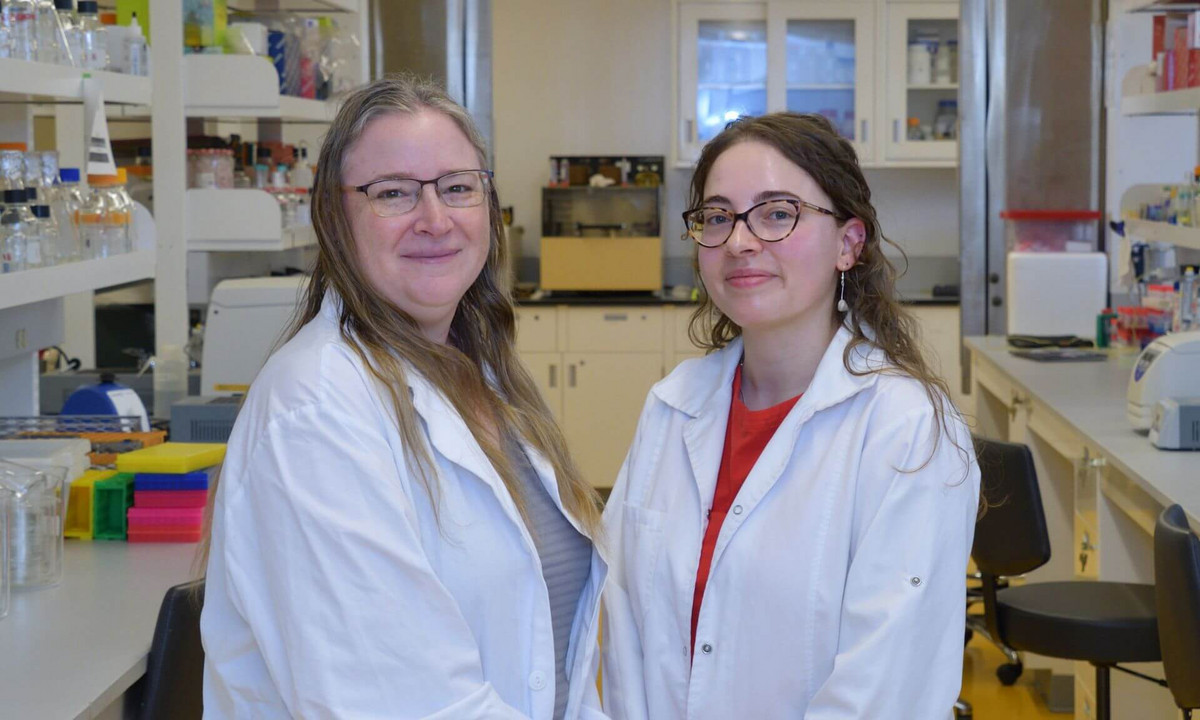
Chloé Frédette, who completed her Ph.D. with Brisson, has published important findings in the journal Water Research. Together, the two researchers created a model for maximizing the evapotranspiration potential of plants.
“Chloé’s project developed an original design for a zero-liquid-discharge wetland that treats industrial wastewater,” said Brisson. “The idea was to completely eliminate all of the contaminated water by evapotranspiration so that none is discharged into the environment.”
A zero-liquid-discharge wetland is a leakproof artificial basin containing vegetation growing in soil and coarse sand. “When the contaminated water passes through the sand, the plants absorb the water and then release it into the air as vapour,” explained Brisson. “The contaminants are immobilized in the sand, thereby eliminating any danger of leaching into the environment. The plants and the bacteria in their roots can also break down some of the contaminants and render them less toxic.”
Such “constructed wetlands” have long been used to treat wastewater, especially in Europe. What is innovative about Fredette and Brisson’s work is that they have modelled a constructed wetland whose parameters can be adjusted to optimize the treatment of leachate, a mixture of rainwater and buried contaminants.
“The big question was how can we design a zero-liquid-discharge wetland when the quantity of water entering the system is unpredictable because it varies depending on rainfall,” said Brisson. “In the end, the solution lies in the shape of the wetland, the choice of vegetation and installation of a temporary storage tank for the water.”
While the model was developed for Montreal’s climate, it can be adapted to any climate by choosing plants that have a high evapotranspiration rate and are suited to local conditions. “This green approach has enormous potential, especially since it is much cheaper than conventional wastewater treatment plants,” Brisson pointed out.