Unlike an animal cell, a plant cell can't crawl or migrate. It's locked inside a rigid wall, cemented to its neighbours for life. A cell born at the centre of a young fruit will still be there when that fruit ripens.
That constraint has a direct consequence. When two tissues are fused together but programmed to grow at different speeds, neither can simply pull away, and something has to give.
The faster tissue puts the slower one under tension; the slower one, in turn, holds the faster one back.
A study by scientists at Université de Montréal shows that this tug-of-war, far from being a mere inconvenience, is one of the tools the plant uses to build its fruit.
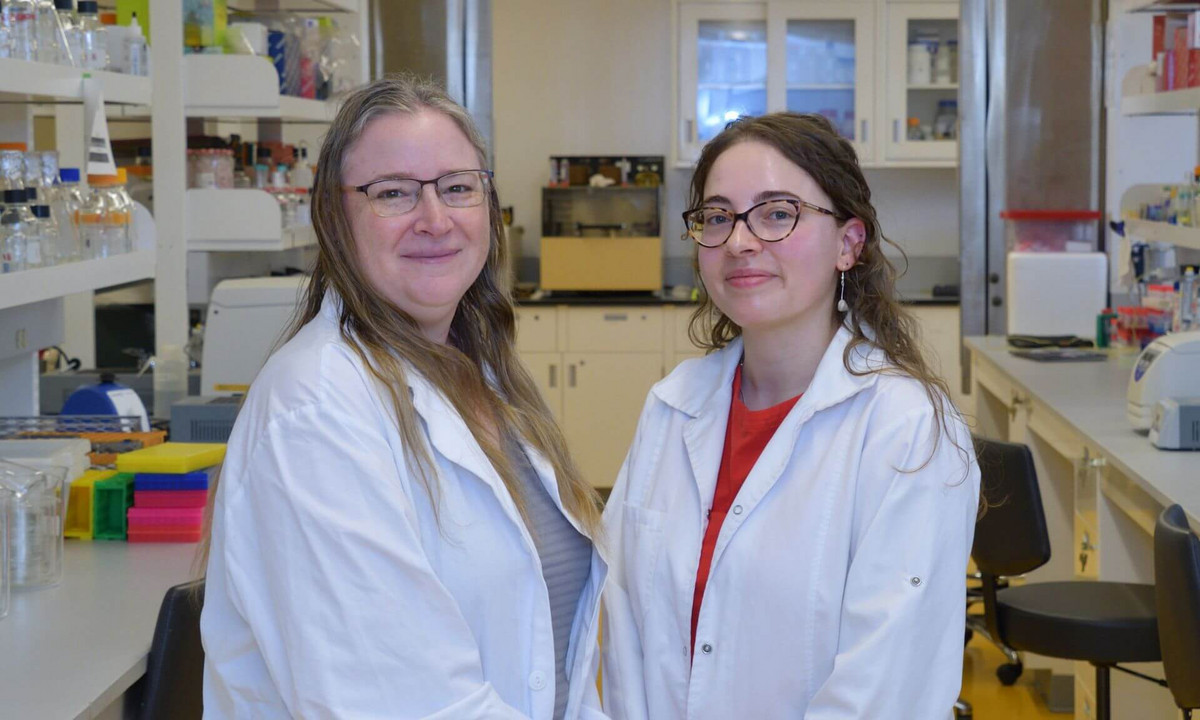
PhD student Binghan Wang led the project, supervised by Daniel Kierzkowski, a professor in UdeM's Department of Biological Sciences and a researcher at the Institute for Research in Plant Biology (IRBV).
The study combines time-lapse imaging, microsurgery, genetics and computer modelling, the latter developed with Richard Smith of the John Innes Centre in the U.K.
Thale cress under the microscope
The team studied Arabidopsis thaliana, or thale cress, a small plant biologists have used as a reference model for decades.
It has a short life cycle, a fully sequenced and well-understood genome, and a broad genetic toolkit that makes it easy to create mutants to test a hypothesis.
What's discovered in thale cress usually sheds light on mechanisms shared by many other plants, such as those in the Brassicaceae family, which includes canola, cabbage, broccoli and others.