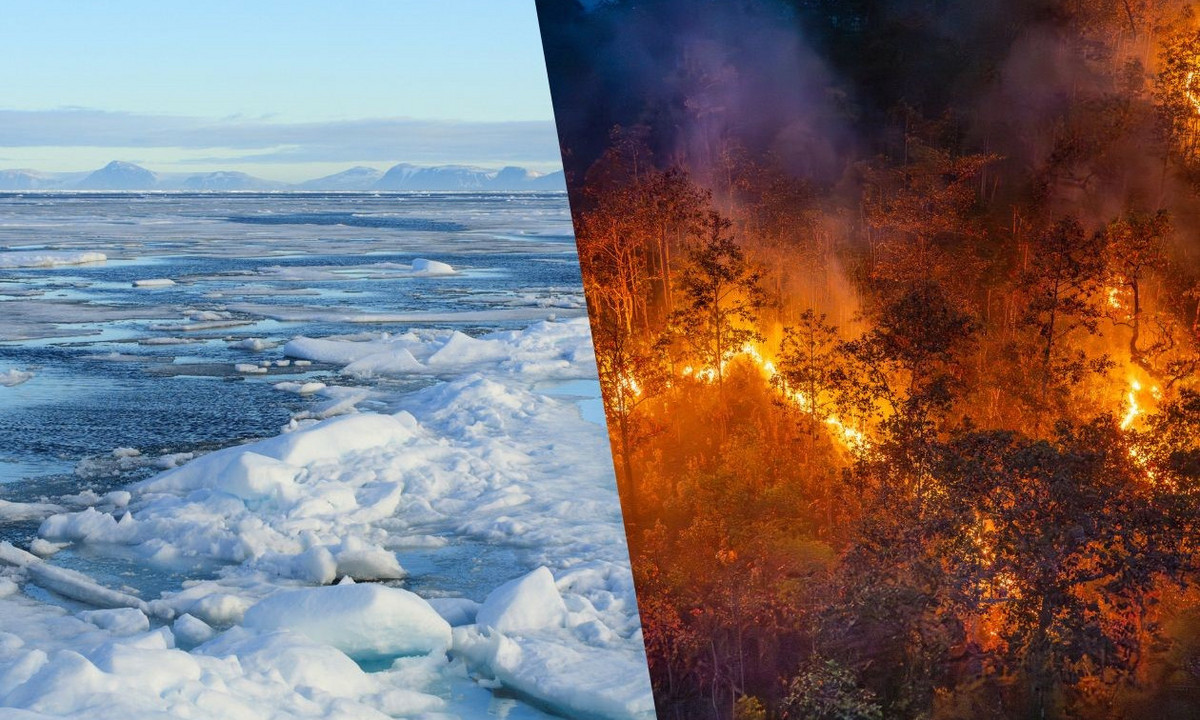
Located in low-lying areas saturated with water, the wetlands that make up 14 per cent of the Arctic emit vast quantities of methane, a potent greenhouse gas. But scientists believe these emissions may be mitigated by the atmospheric methane uptake that occurs in the Arctic's uplands, which are well-drained and cover more than 80 per cent of the polar region.
So far, however, scientists have had trouble measuring, understanding and evaluating the underlying mechanisms, environmental controls and magnitude of methane uptake in these so-called upland "sinks". Now an international study finds this uptake may be larger than previously thought, and that it may increase under drier conditions.
Led by Université de Montréal geography professor Oliver Sonnentag with his former postdoctoral researcher Carolina Voigt, the study is published today in Nature Climate Change.
"Scientists in the Arctic tend to install all their flux measurement instrumentation at locations where high methane emissions can be expected, and our work reduces this bias by quantifying methane uptake in the uplands and by shedding light on the controls of that uptake," said Sonnentag, a Canada Research Chair in atmospheric biosciences who designed the study and is its principal investigator.
At Trail Valley Creek, an upland tundra site on permafrost 45 kilometres north of Inuvik, Northwest Territories, in the western Canadian Arctic, the UdeM team used a unique experimental set-up consisting of 18 automated chambers to continuously measure methane fluxes. No other automated chamber system exists this far north in the Canadian Arctic, and only few exist above the Arctic Circle globally, most of them installed at sites where methane emissions are significant.