3D-printer waste gets a second life

In 5 seconds Thanks to the FilUM project, more than 40 kilograms of scraps from 3D printers in UdeM's labs and libraries have been collected and recycled.
More than 40 kg of 3D printing scraps were reused.

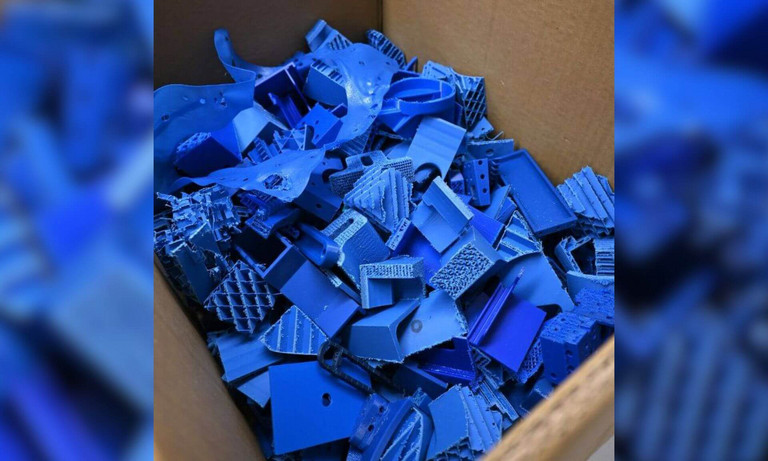
For months in Université de Montreal labs and libraries, multicoloured jumbles of 3D-printer waste—failed prints, fragments of support material, scrap filament—were piling up in boxes. No recycling solution was available.

Now there is. Under the FilUM initiative, UdeM libraries are shipping the waste to the laboratory of Audrey Laventure, a professor in the Department of Chemistry, to be transformed into filament for 3D printing.

Launched in 2025 with the backing of the Office of the Vice-Rector for Research and Innovation’s environmental responsibility research fund, FilUM has so far recovered over 40 kilograms of polylactic acid (PLA), the polymer in the filament used to print.

And the project is picking up steam. In early 2026, FilUM received a grant from the Royal Society of Chemistry’s Sustainability Fund.

Piles of waste

3D printing is being used increasingly in UdeM’s research laboratories and the libraries' digital fabrication workshops. But a print job can fail. Incorrect settings can lead to multiple unsuccessful attempts. Some complex items require support structures that are removed and discarded after printing.

3D printer manufacturers estimate that these scraps account for anywhere from 10 to 40 per cent of all the PLA filament that's used.

PLA is not easy to dispose of. It is marketed as a compostable material, but it requires very specific conditions to degrade. 

“Yes, technically, this polymer is compostable, but it won’t actually compost under normal environmental conditions,” said Stéphanie Poirier, a research advisor and member of the project team. “PLA must be composted in specialized industrial facilities. Unfortunately, these are not widely available in Quebec.”

The team surveyed 3D-printer users across UdeM, mainly in the digital fabrication workshops in the libraries and the research laboratories in the Faculty of Arts and Science, Faculty of Medicine and School of Optometry, to find out what they were doing with their waste. 

“Most people said they were storing boxes of scraps and didn’t know what to do with them,” Poirier said. The plastic was being set aside until a solution could be found.

Shred, melt, rewind

“To be recycled, the scraps first have to be sorted by colour and then shredded into small granules,” Laventure explained. “These are then heated in an extruder, which turns them into a long filament that is wound onto a spool.”

The scraps are collected through the library system. Waste from the digital fabrication workshops is centralized at the Hubert-Reeves library on the MIL campus. The research laboratories can also send their scraps to Hubert-Reeves via internal mail or deliver them to six other collection points. When enough PLA has accumulated, the FilUM team picks it up.

In line with the recycling ethos, the empty spools are also reused. Once the FilUM team has produced the recycled filament, it is rewound on used spools from the libraries. The team then returns the spools and the recycled filament is reused within the university.

Tests show that the recycled filament can be used to produce new parts, particularly for prototyping. It is not suitable for all applications, however. For now, FilUM is working with additive-free PLA and isn’t using filaments containing specific components such as Galaxy PLA (which contains glitter) or PLA-CF (which contains carbon fibre).

Pooling is key

Shredders and extruders are expensive. Using them takes time, labour and expertise. The investment would be hard to justify for a single lab with a few handfuls of plastic to recycle. Pooling the scraps generated across the entire campus changes the calculus.

“With a campus-wide initiative, we can collect enough scraps to produce full spools of filament, which makes FilUM’s equipment cost-effective,” Poirier said.

The FilUM team now wants to take that logic further and expand collection to campuses outside Montreal and to the university's affiliated centres.

Learn more about FilUM: https://en.laventurelab.com/filum

Find out more about the libraries’ digital fabrication workshops: https://studio.bib.umontreal.ca/creatives/impression3d

Media requests

Université de Montréal
Phone: 514-343-6111, ext. 75930