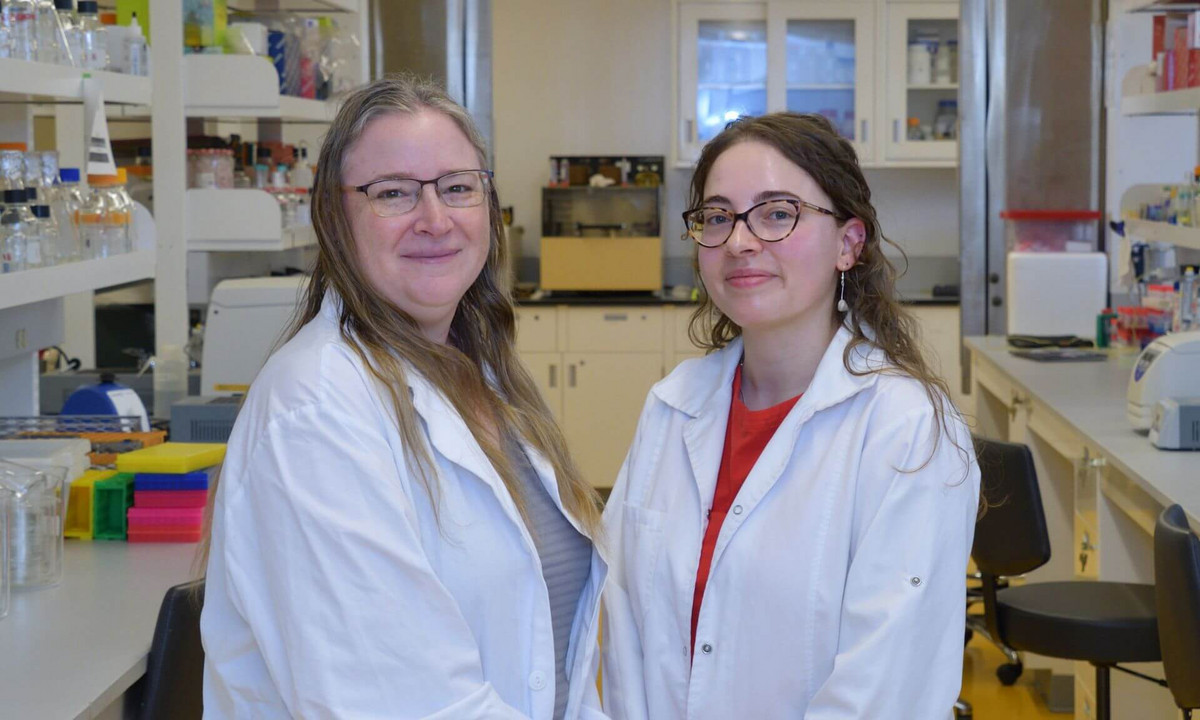
“There is a lot of talk about deforestation and biodiversity loss in the Amazon, but even here in Colombia there is much less said about the tropical dry forest, although it is also an extremely rich ecosystem—and one that is under severe threat,” warns Colombian researcher Maria Isabel Arce Plata.
A doctoral student in biology at Université de Montréal supervised by UdeM biology professor Timothée Poisot and co-supervised by Natalia Norden, research coordinator at the Instituto Alexander von Humboldt in Colombia, Arce Plata studied this ecosystem by analyzing changes in the habitats of more than 700 species of birds, mammals and plants between 2000 and 2020.
Published in January in Ecological Indicators, her work reveals profound degradation but also potential avenues for action.
Unlike rainforests, tropical dry forests (TDFs) are adapted to dramatic seasonal changes, including months without water during which the trees shed their leaves to survive. These forests feature exceptional biodiversity shaped by the extreme climatic conditions. Many species found in TDFs exist nowhere else on Earth.
But around globe, TDFs are disappearing at an alarming rate.
Over 10 million hectares destroyed
The one in Colombia, for instance, has been decimated. Of an estimated 11 million hectares, only about 650,000 to 730,000 hectares remained in 2020—less than 7 per cent of its original area.
“Forest loss resulted from a wide variety of land cover transitions, yet conversion to pasturelands dominated land cover change,” Arce Plata's study explains. “Indeed, about half of the 11 million hectares originally covered by TDF have been converted to pasturelands, followed by arable land and plantations.”
With approximately 5.5 million hectares now occupied by pastureland and used for extensive livestock farming, forest flora and fauna have lost 80 to 90 per cent of their habitat, as well as their ability to move between habitats.
The destruction of Colombia's tropical dry forest has accelerated in recent decades. In 1990, approximately 1,037,435 hectares of TDF remained. By 2020, this figure had fallen to just 652,869 hectares—a loss of nearly one-third of the remaining forest cover in only 30 years.
Today, the landscape is fragmented, consisting of small, isolated patches of often degraded forest. “The largest remaining areas of forest are in the north of the country and in the Orinoco region,” Arce Plata said. “And it is precisely these areas that continue to lose forest cover and habitat for flora and fauna.”
Using biodiversity indicators
To measure the impact of these changes, Arce Plata did not rely solely on traditional indicators based on forest area. Instead, she applied the Species Habitat Index (SHI), which governments use to measure their progress towards biodiversity conservation targets, including their obligations under the Kunming-Montreal Global Biodiversity Framework.
“Forest cover is often used as a conservation indicator,” Arce Plata explained. “But just because there is forest somewhere doesn’t mean that all species can thrive there. The SHI takes habitat quality and connectivity into account.”
The SHI compares the state of habitats to a baseline year and assesses changes in their size, quality and ability to form a functional network over time. To apply it, Arce Plata modeled the distribution and dispersion of each species studied, including 237 birds, 68 mammals and 450 plants found in the tropical dry forest.
The results show that between 2000 and 2020, approximately 20 per cent of habitats and their connectivity were lost for the 755 species analyzed. Compared to the original size of the ecosystem, 80 to 90 per cent of habitats have disappeared.
“One might think that since the ecosystem is already severely degraded, it can’t really get any worse,” Arce Plata commented. “But our results show that we still have a lot to lose, especially in terms of connectivity.”
Not all species are equally affected by the fragmentation of forest cover. Mammals are more vulnerable than birds or plants. “They are experiencing the greatest habitat loss,” Arce Plata explained. “And they are also key species for ecosystem functioning.”
Large mammals play a central role in forest dynamics by dispersing seeds. Their disappearance opens the floodgates to a cascade of effects that can also impact human communities. “When large mammals decline, we see more conflicts,” said Arce Plata. “We start to see more animals eating chickens or crops. These are indirect effects of habitat loss.”
A glimmer of hope
Despite this bleak picture, Arce Plata sees a glimmer of hope: there are more than a million hectares of “successional forests,” forests that are growing back on abandoned pastures and farmland.
“The area of these new-growth forests is greater than that of the remaining mature forests,” said Arce Plata. “These ecosystems have the ability to recover.”
There has been a modest increase in forest cover in some of Colombia's hardest hit regions. This suggests that recent strategies—ecological restoration, biological corridors and integrated land-use management—are beginning to have an effect, although their long-term impact is difficult to determine.
Arce Plata believes these results support a more inclusive approach to conservation. “Forests today are surrounded by productive lands,” she noted. “Working with local communities is essential. Human activities could also contribute to connectivity, if they are reimagined.”