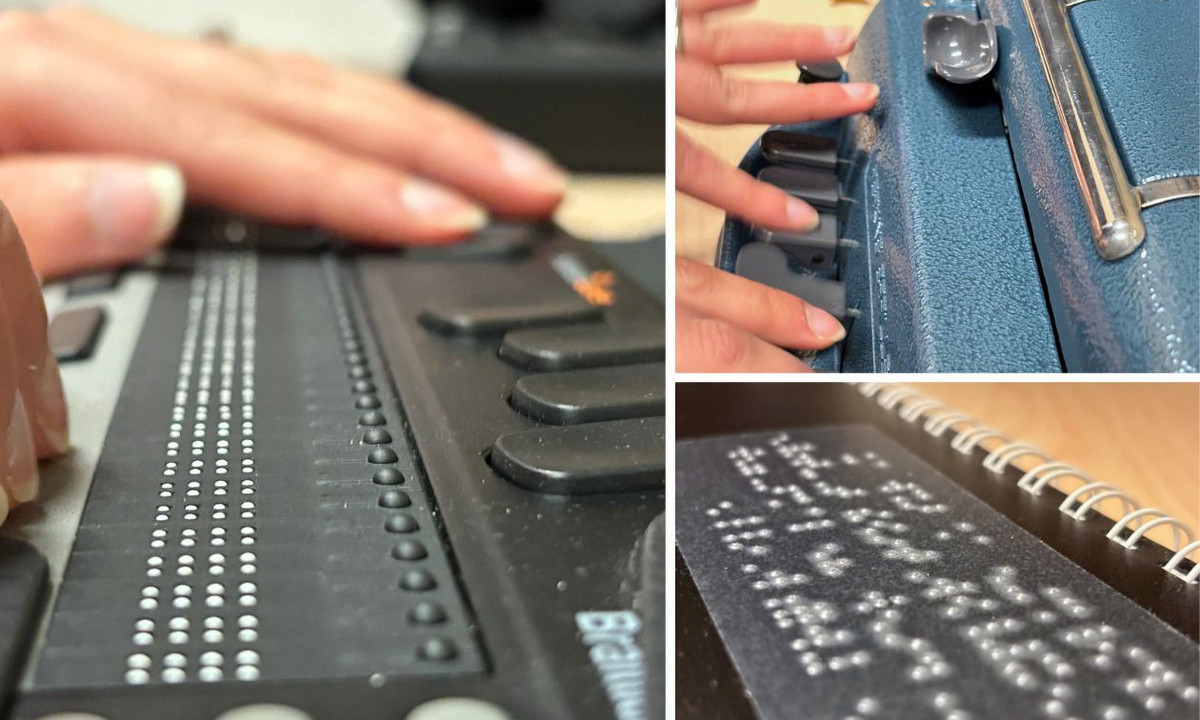
Braille: an underutilized tool

In 5 seconds An UdeM study finds that orientation-and-mobility specialists don't make much use of braille with their adult clients, and concludes that the university training should be improved.
More than just a reading tool, braille is a way for blind people to navigate their surroundings. However, most orientation and mobility specialists incorporate it little or not at all into their work with blind adults.

For a blind person, braille is more than just a tool for reading books. It's essential for navigating space, and is used on everything from signage to elevator buttons to 3D tactile maps. 

Yet very few orientation-and-mobility (O&M) specialists —  professionals trained to help people with low vision or blindness move around independently and safely — incorporate braille in their work with adults.

That's the finding of a study by Joseph Paul Nemargut and Natalina Martiniello, assistant professors at the School of Optometry at Université de Montréal, and Marie Mansour, an O&M specialist.

84 per cent rarely or never use it

Their study is based on a survey done between May and December 2021 of 44 O&M specialists in Canada and the U.S. These two countries were selected because their university training programs are similar.

The participants were a representative cross-section of the profession: 86 per cent women with an average age of 46 and 17 years of professional experience.

Overall, 84 per cent of respondents reported rarely or never using braille in their practice. That figure climbed to 90 per cent among those working exclusively with adults. 

By contrast, only 44 per cent of O&M specialists working exclusively with children said they rarely use it, and none reported never using it.

“O&M specialists believe braille is useful, but they use it more with children,” said Martiniello, who believes that several factors explain the difference.

One is that in adult rehabilitation, clients receive braille training from certified vision-rehabilitation therapists in conjunction with O&M services, reducing the need for O&M specialists to use braille.

But there is a second, more concerning explanation: O&M specialists working with adults often lack confidence in their braille skills, which directly impacts how much they use it in their practice.

Trained to use it, but don't

It’s worth noting that half of the respondents received braille training as part of their university program, while the others received it outside of that setting.

While the majority said they were generally satisfied with their braille knowledge, 39 per cent said they were not. And 59 per cent said they were dissatisfied with or indifferent to the braille training they received at university.

However, satisfaction levels varied depending on the clientele. This was particularly evident among O&M specialists working exclusively with adults: only 40 per cent said they were satisfied or very satisfied with their braille training, compared to 89 per cent of O&M specialists working exclusively with children.

Nemargut pointed out that this difference is partly because specialists working with children are more often dual-certified as both O&M specialists and teachers of students with visual impairments, which gives them more in-depth exposure to braille.

Despite these perceived gaps, only 25 per cent of respondents felt they require additional training. However, 41 per cent believed that a full course on braille should be part of university O&M programs, and 55 per cent said that basic proficiency in braille (Grade 1 level) should be a requirement for professional certification.

Less likely to recommend it

For Nemargut, the issues go beyond individual competence, because a specialist who is not proficient in braille will be less likely to spontaneously recommend it to clients. 

“Continuing education is a way to acquire basic braille skills,” he said, adding that online learning platforms now make learning braille more accessible.

Martiniello also stressed the importance of early intervention.

“When a person is experiencing a gradual decline in vision, the sooner they learn braille, the better,” she said. “That way, when a significant change or loss of vision occurs, they’re already prepared to use their non-visual skills.”

The study’s authors believe their findings underscore the need to review university programs for O&M specialists, especially those serving adults.

At the master's level at UdeM, all students training to be O&M specialists have access to courses in braille—a necessary step, according to the researchers, for ensuring high-quality rehabilitation across all age groups.

Media requests

Université de Montréal
Phone: 514-343-6111, ext. 75930