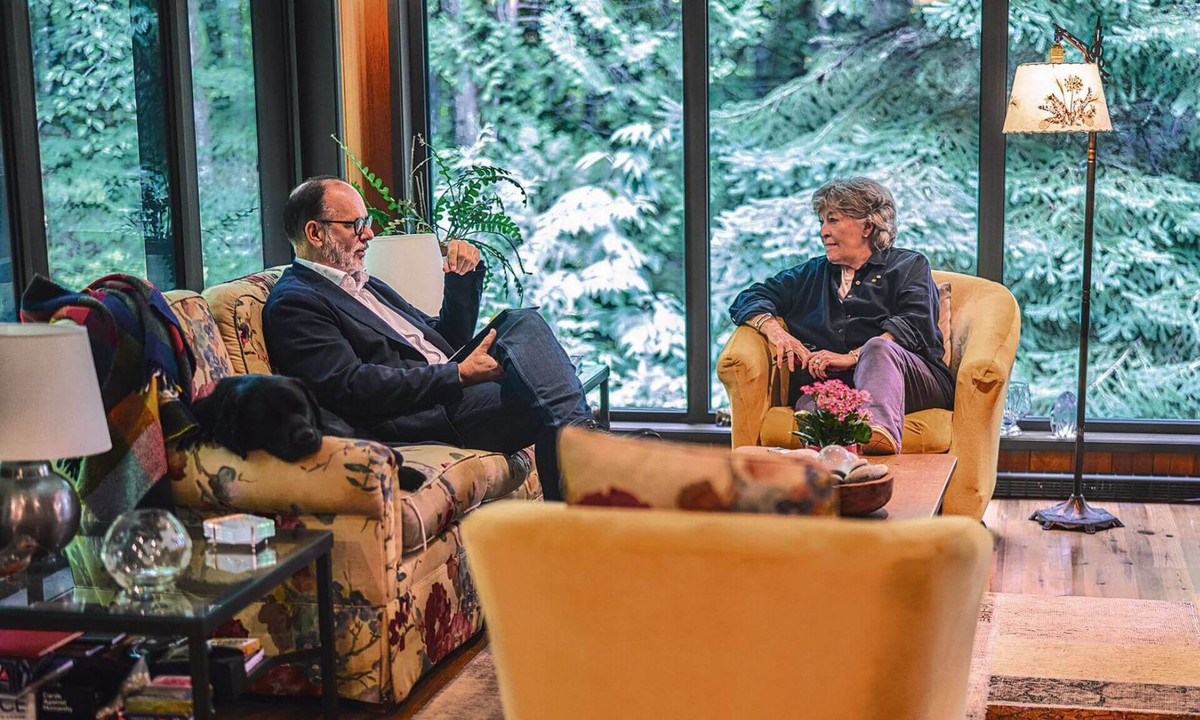
When Alain Roy began his career as a law professor in the late 1990s, Quebec family law still bore the imprint of the large-scale reforms adopted in the early 1980s, in the wake of the Quiet Revolution.
These reforms led to major progress in the law, particularly by enshrining equality between spouses and between parents and children, marking a major break with the more traditional structures of the past.
Barely two decades later, however, this legal framework was already showing its limitations. Family realities were evolving rapidly, with a diversification of marital models and a transformation of parental roles.
Faced with these changes, family law was struggling to keep pace. “We noticed a disconnect,” Roy recalled.
This disconnect would his chief motivation in a career spent rethinking the foundations of family law, with one constant guiding principle: that people, especially children, should be at the heart of things.
Roy's commitment to act on this principle would permeate all of his work and would earn him recognition in many forms, including the Quebec Justice Award, the province’s highest legal distinction.
An early calling
Roy’s sense of commitment sprang from his background. The youngest of six children, he grew up among siblings who followed very different life paths. It was, he remembers, a “true laboratory.”
All adopted, each of his brothers and sisters had their own story, their own experiences, and their own strong identities. He himself was born “against all odds,” because his parents believed they could not conceive.
This set of circumstances shaped Roy's perspective as he matured. Where others saw legal categories (adoption, parentage, parenting), he saw, first and foremost, human stories, unique journeys and deep-seated identity issues.
Very early on, he questioned the place of the child within these structures and the role of family law in regulating family relationships.
It is no coincidence that he devoted his early work to adoption and the right to know one’s origins. In 2006, he published a book on adoption in Quebec. At a time when adoption and related matters were still sensitive and sometimes even taboo issues, he helped bring them to the forefront of legal debates.
His interest in law is part of a broader quest for social justice. “The law appealed to me as an instrument for regulating human relationships,” he said. As a result, family law became his prime area of focus.
Rethinking the foundations
In the early 2000s, there were increasing signs of a disconnect between law and society in Quebec, Roy recalled.
Assisted procreation was being developed, surrogacy was becoming a reality, more people were entering into common-law relationships, and the demands of same-sex couples were gaining greater visibility.
“At the time, family law was evolving in a fragmented way and change was often driven by the courts and charters of rights,” Roy explained. “Unfortunately, it struggled to offer a coherent overall vision.”
It was against this backdrop that, in 2013, the Supreme Court of Canada handed down its decision in the case of Eric v. Lola.
Recognizing that common-law partners did not enjoy the same protections as married couples, the Court highlighted the significant structural inequality between common-law and married couples and the need for comprehensive reform.
The Quebec government chose to go beyond an ad hoc response to the decision. On April 19, 2013, then-Justice Minister Bertrand St-Arnaud created an advisory committee on family law and appointed Roy as its chair.
Its mandate: to propose a comprehensive reform of family law encompassing marriage, civil unions, common-law relationships, parentage, parenting, assisted procreation and surrogacy.
Two years later, the committee’s work culminated in an ambitious proposal, commonly known as theRoy Report, which included 82 recommendations and redefined many aspects of family law in Quebec.
In April 2019, the minister of justice at the time, Sonia LeBel, appointed Roy as an expert advisor for public consultations on family law reform. Then, in October 2020, the new justice minister, Simon Jolin-Barrette, retained his services as a special advisor on the three bills that would make family law reform a reality.
A centerpiece of the law
Recognition of the right to know one’s origins was one of the centrepieces of the new legislation. For a long time, adopted children and those conceived through assisted procreation were deprived of information about their parentage. Now this right is enshrined in Quebec's Charter of Rights and Freedoms.
“Thanks to the reforms, the child is recognized as a legal subject in their own right, whose interests should not be systematically subordinated to those of adults, as was the case in the past on this specific issue,” Roy said.
The reform also introduced a legal framework for surrogacy, regulating prospective parents’ plans and protecting surrogate mothers. Another important innovation is the creation of parental unions, intended for common-law partners with a child. The new regime recognizes parents’ rights and obligations to ensure protection of children in the event of separation.
Finally, stronger provisions on spousal, family and sexual violence provide the courts with more appropriate and effective tools. In Roy’s view, “Quebec has gone from lagging behind to taking the lead on these issues.”
Effects of the reform already felt
While some measures will require time to have an impact, particularly those related to parental unions between common-law partners who gave birth or adopted a child after June 29, 2025, other changes are already being felt.
For example, Bill 12 respecting surrogacy now provides for extrajudicial recognition of parental plans recorded in notarial agreements.
“I’ve been in contact with notaries who have received a number of parental plans since the bill was passed,” said Roy.
“Some of these plans might not have been possible without the new framework or would have been made in a legal vacuum that would be very unsafe for the children.
"Many court rulings are already applying provisions that provide better protection in cases of domestic, spousal and sexual violence. This is a sign that the reform addressed pressing needs.”
The reforms are not the end goal but a step forward. One of the unresolved issues is lack of consistency among the different marital regimes. Marriages, civil unions, parental unions and common-law partnerships coexist in Quebec society, but they are not necessarily subject to a harmonious, coherent set of legal rules.
Why, for example, does the law impose mandatory division of family assets on married couples without children, while common-law partners without children enjoy complete freedom? This asymmetry raises questions of legislative consistency, Roy said.
“We still have to fit a number of pieces into the jigsaw to make it complete."
Rethinking vulnerability, even for animals
Roy has been reflecting more broadly on the notion of vulnerability. In his opinion, the law must pay special attention to all beings that are in a position of weakness: children, surrogate mothers, the elderly, and also animals.
The foray into animal law is a natural progression, Roy feels.
“It was children’s rights that prompted me to explore the issue,” he explained. Like children in the past, who were undervalued because they couldn’t speak, animals were long perceived as objects, without any real legal status, he noted.
But attitudes are changing. Since 2015, the Quebec Civil Code has recognized animals as sentient beings, even though in practice, and particularly in family law, they are still often treated as property. During a separation, a pet can become a point of contention, even a tool for coercion.
“But a dog isn’t a dishwasher; and both for the dog’s sake and for the children who are attached to the dog, we can’t turn a blind eye to this situation," said Roy, who at UdeM created the first-ever course in animal law.
“Legislators would be wise to address this issue head on and adopt appropriate rules for cases of family breakdown, as authorities have done elsewhere.”
His ideas on the matter illustrate a broader conviction: empathy should not be ranked.
“Caring for animals does not mean neglecting children or the elderly,” he argued. “Empathy is not a finite resource.” A society attentive to all forms of vulnerability is a more just society, he said.
Teaching as a living laboratory
Alongside his research and consulting activities, Alain Roy devotes much of his working life to teaching. He considers his teaching role essential, both for training the next generation and for enriching his own thinking.
“Students are an extraordinary laboratory,” he said. In his classrooms, he can observe changes in attitudes and in society. Discussions with students give him an opportunity to question legal assumptions and anticipate future challenges.
A striking example concerns the sharing of pension plans in parental unions. He was initially in favour of it in the event of separation, but he reconsidered his position after discussions with his students.
They pointed to the potentially adverse effects on women, who often have jobs offering more advantageous pension plans (e.g. nurses, teachers and public servants) and could lose a significant portion of their accrued benefits.
As a result of these discussions, it was ultimately decided that the parental union regime would not provide for the automatic sharing of pension plans.
Today, Roy is writing a treatise on family law that will synthesize his reflections over many years in the hope of enlightening other stakeholders in the legal world.
He wants family law to continue to progress. It cannot afford to lag behind the real-world situations it governs, he feels.
“We shouldn’t have to wait 30 years for the next reform. The law should be a living tool, evolving in step with social changes and always paying attention to the most vulnerable.
"As Gandhi said, ‘The true measure of a society can be found in the way it treats its most vulnerable members.’”