Mauled by a bear, 27,500 years ago

In 5 seconds In a study co-authored with Julien Riel-Salvatore and Claudine Gravel-Miguel from UdeM, Italian scientists reconstruct what they think likely killed a teenager in Liguria during the Paleolithic era.
A: Geographic location of Arene Candide in northern Italy, with the Liguria region highlighted in red. B: Zenithal view of the “Il Principe” burial, as displayed at the Museo di Archeologia Ligure, Genova Pegli. The photogrammetric model was created for this study. C: a view of the eastern hall of Arene Candide Cave.

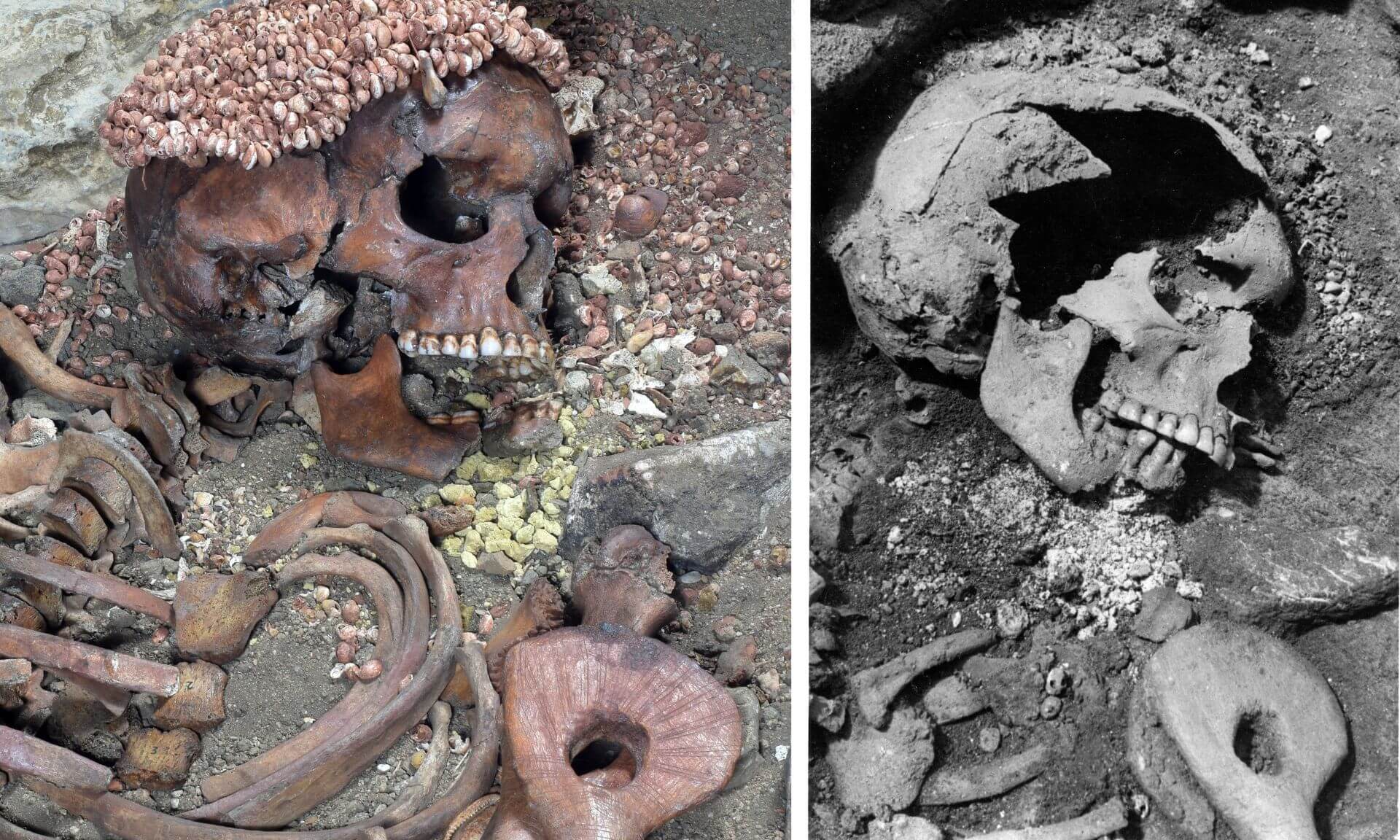
The teenager's skeleton lay supine in a shallow pit on a bed of red ochre, his remains adorned with several ivory pendants, four perforated antler batons, mammoth ivory pendants, and a flint blade, his skull decorated with hundreds of perforated shells and several deer canines.

But there was something else that archeologists noticed when they unearthed the ancient remains at the Arene Candide cave in northwestern Italy in 1942: signs of significant trauma to the body at the time of the young man's untimely death.

His collarbone, jawbone, one shoulder blade and the top of an upper arm bone were all smashed or otherwise damaged, as were the cervical vertebrae, with those and some missing parts replaced with a large lump of yellow ochre, seemingly to cover his wounds.

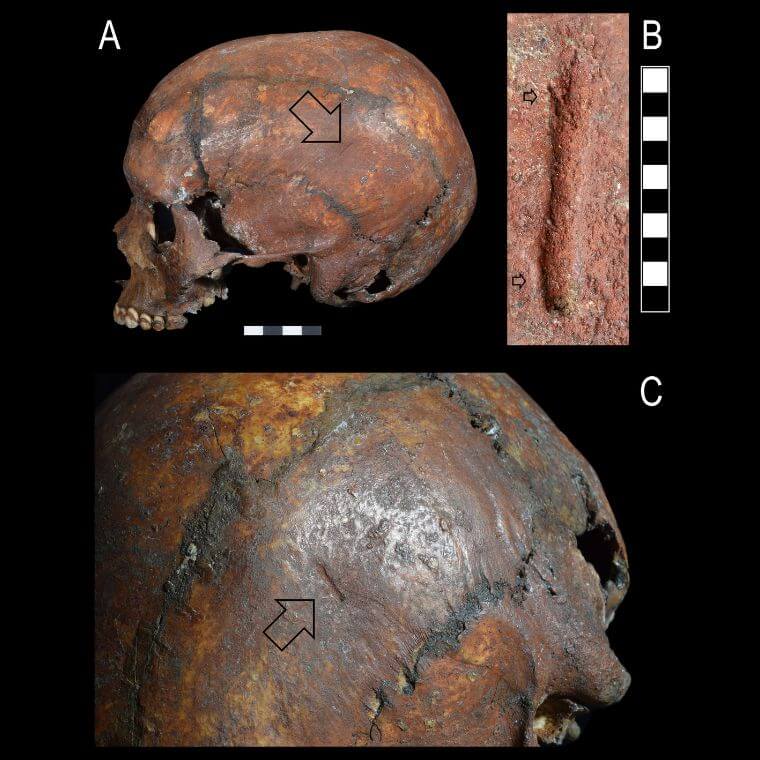
There was a clearly defined linear incision on the skull, too.

What had happened? Had the youth been injured in a hunting accident, had he been attacked by a bear or a big cat, or maybe by something else, even a human? Or had he simply fallen from a height? And did he die instantly, or suffer a lot?

No one could say for certain — until now.

In a new study co-authored with Université de Montréal anthropologists Julien Riel-Salvatore and Claudine Gravel-Miguel, an international team of scientists led by University of Cagliari bioanthropologist Vitale Stefano Sparacello painstakingly reconstruct what they think likely killed the teenager some 27,500 years ago.

"This is an exercise in osteobiography that reveals the final moments of a teenager in the Paleolithic era in what is today the region of Liguria," said Riel-Salvatore, a professor and chair of UdeM's anthropology department.

“We can say with great certainty that the youth fell prey to a large carnivore, most likely a bear. He then survived his injuries for some time in agony before dying and being buried lavishly, hence his nickname Il Principe, 'the prince' of Arene Candide Cave.”

It's a significant finding, he added.

"This is one of the very rare cases where we are able to determine the cause of death of a person in the Palaeolithic era."


Extremely rare evidence

Despite ample evidence that Paleolithic humans hunted large and dangerous carnivores, such as lions, leopards, and bears, skeletal evidence of negative interactions with wild fauna is extremely rare in the Homo sapiens paleobiological record.

The Principe (so named for the richness of the goods found in his grave) is an exception.

Working with the skeleton preserved in the archaeological museum of Pegli, in Genoa, Sparacello and his colleagues from several institutions re-analyzed the boy's lesions and systematically examined the remains for additional evidence.

Their goal: to reconstruct the manner and circumstances of the young man's death.

"Our analysis confirmed the perimortem nature of the mandibular and shoulder lesions and identified other possible fractures related to the violent event in the cranium, dentition, and possibly the cervical spine," they note in their study.

"Additional perimortem trauma, including a linear marking on the left parietal and a puncture mark in the fibula, supports the hypothesis of animal mauling," they continue. "Given the overall traumatic pattern, a bear attack ... remains the most plausible explanation."

Significantly, the teenager's bones show signs of early healing, indicating he survived two to three days after the attack, suggesting that major arteries were not severed. He likely died from organ failure, internal bleeding, or severe brain trauma.

The study also revealed that the Principe was lame: he'd previously sustained traumatic injuries to his feet, namely a fracture of the left little toe and osteochondritis dissecans in the right talus. So, the theory goes, once attacked, he couldn't hobble away fast enough to escape.

This confirms what anthropologists have long believed about prehistoric foragers: any significant injury to their lower limbs left them vulnerable to violent attack by large predators such as bears — and an early death.

An elaborate burial

In the Principe's case, the unfortunate teenager's long agony may have been reflected in his elaborate burial, the scientists argue in their study.

The extravagant goods found in his grave may reflect a “ritual sanctioning” of the traumatic event by those who buried him, rather than any social rank he may have held, they write.

In other words, he was given an elaborate burial as part of a ritual response to his suffering.

This theory aligns with patterns seen in other lavish burials of the time, which frequently involved people with unusual injuries or disfigurements.

“This pattern supports the hypothesis that formal burial was granted to ritually contain and acknowledge ‘exceptional events and exceptional people,’” the co-authors write.

Share