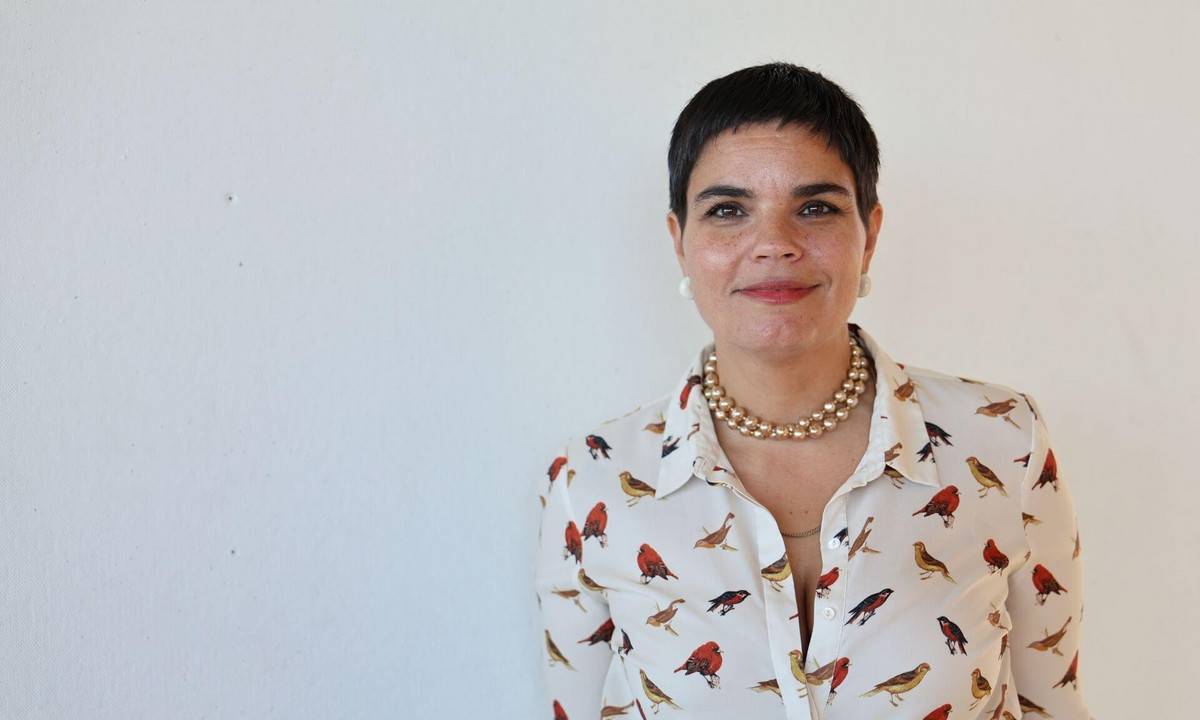
For her master’s degree in applied ethics, Saja Farhat examined contemporary forms of oppression: people being marginalized, rendered powerless, run roughshod by cultural imperialism.
Those forms of oppession have become so normalized within today's neoliberal political and economic system, the Université de Montréal student felt, that they often go unnoticed and unchallenged.
Now, for her doctoral studies, again in UdeM’s Department of Philosophy, this time on a three-year, $25,000 Bourse de la Montagne scholarship, Farhat wants to focus on finding solutions to these ongoing injustices.
“Many people in education, health and community settings understand these issues and want to change things, but they often feel alone, worn out and powerless,” she said. “So I asked myself: how can we create conditions in which everyone can get involved and not have to shoulder the burden alone, in which action is collective?”
To answer this question, Farhat sought to identify the levers that support, coordinate and sustain collective engagement—both normative levers that shape behaviour through shared values and institutional levers embedded in formal structures. These instruments are present in structured organizations, including citizen-led social movements and public institutions in health, education and culture.
“The goal is to understand how we can move from individual action to a shared, collective ‘we’ that connects people, supports their engagement and promotes genuine coordinated action,” Farhat explained.
Moving beyond 'me and you'
For her doctoral research, Farhat is working from real-world observations to develop theoretical insights.
“Although my analyses aren’t yet complete, I can say that creating this ‘we’ requires moving beyond the ‘me and you’ and ‘us and them’ dualities – we need to build a collective ‘we’ that unites without erasing differences,” she said. “This insight comes from many years spent in community and institutional settings, and from working closely with people in vulnerable situations.”
This emphasis on human connections runs throughout Farhat’s academic career. While she initially pursued mechanical engineering in college with the dream of becoming an aerospace engineer, she ultimately changed course to follow her growing interest in ethics and social engagement.
“I left after my first year in engineering because connecting with others is important to me and I wanted to work in a field that reflects my values,” she explained.
Recalling how much she had enjoyed her Ethics and Politics course in CEGEP, at Collège de Maisonneuve, she decided to pursue a bachelor’s degree in philosophy at Université de Montréal.
“I wanted to gain a deeper understanding of society through concepts and theories in order to better serve people and communities,” she said. “I believe that when philosophy is in dialogue with lived experience, it can help us make sense of social realities and provide tools for collective reflection.”
A morale-booster
Getting a Bourse de la Montagne scholarship in 2025 was a morale-booster for Farhat.
“It means that people believe in you and in the transformative power of what you are doing – for a doctoral student, that’s no small thing!” she said. “The focus is often put on individual responsibility, but to think, create and make a meaningful contribution to society, you also need the conditions that make it possible. That’s what this scholarship gives me: the time and stability to work with integrity and rigour.”
Another core value that guides Farhat is humility.
“When you start exploring these issues, you quickly realize that you don’t have all the answers,” she explained. “You’re constantly learning from others, both through the articles you read and the discussions you have. It requires genuine openness.”
Farhat is also working hard on her listening skills, convinced they are the foundation of good communication.
“Listening is not just responding—it’s first and foremost about understanding,” she said. “You also need a strong ethical sense to ask the right questions and recognize your own blind spots.”
Farhat knows that changing complex realities takes patience and perseverance, and she intends to bring this mindset to her future work in both research and community action.
“I would like to serve as a bridge between the two: I want research to be informed by what’s happening in the real world, and action in the real world to be grounded in rigorous reflection,” she said.
“For knowledge to be meaningful, it must serve people and communities.”