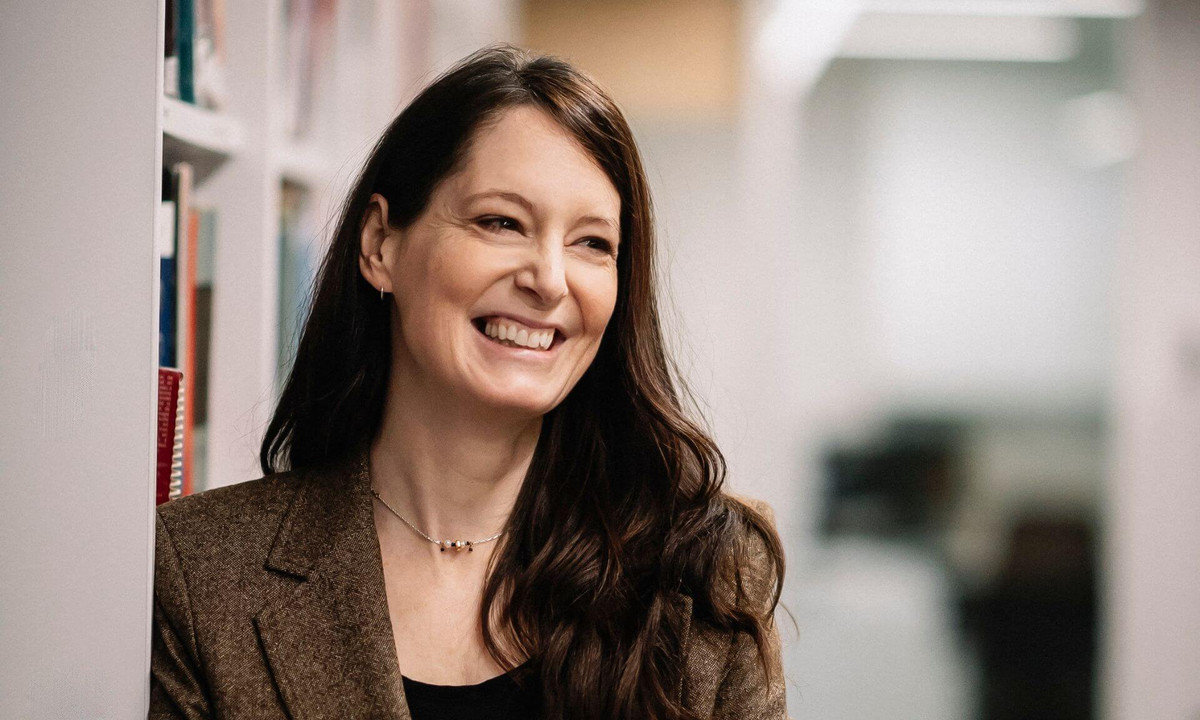
Women's housing collectives are a rare thing in Quebec and the rest of Canada. That piqued the interest of Université de Montréal doctoral student Raquel Fernandez, who brings a unique background to the subject.
After working as a general contractor in the residential, commercial and institutional sectors for 15 years, Fernandez decided to study environmental design, and in 2023 she began her master’s degree at UdeM under the supervision of Olivier Vallerand.
Fernandez was interested in how the built environment in Montreal shapes women’s sense of safety and belonging. She then fast-tracked into the PhD program to study women’s collective housing from an intersectional feminist perspective.
“My business experience shaped my studies because I’ve seen both the strengths and limits of what is being done in social housing,” she explained.
Her choice of topic is also closely tied to her personal story.
“As a queer woman, the daughter of immigrants and the mother of a 15-year-old Inuit teenager adopted at eight months and raised in a same-sex family, safety is a vitally important issue to me,” she said.
Women manage themselves
Researchers began examining collective housing in the 1970s, but the topic remained on the margins. Interest surged in the 1980s, but since 1990 there has been virtually no research. Fernandez wanted to revisit the issue amid the current housing crisis.
Women’s housing collectives are residences that are self-managed by women and have a communal dimension. “In these homes, there is generally a division of labour and a shared space,” Fernandez explained.
“In the early days, there were often collective daycare services as well. Of course, the women living there may have sons and male partners but basically these are feminist spaces created and managed by women for women.”
In addition to four such places she's looked at in Quebec, Fernandez is studying examples from the rest of Canada, past and present. Some have closed but around 20 remain. “I want to understand why and how they have survived,” she said.
Fernandez is also concerned with inclusion.
“I am asking how these environments are influenced by societal changes, particularly the inclusion of gender-diverse people and the LGBTQ+ movement,” she said. “Have existing power relationships been transposed into these spaces?”
A new perspective
Fernandez believes the housing crisis must be viewed from multiple angles.
“If we approach it as a gendered crisis, we find that single mothers, LGBTQ+, racialized, immigrant and older women have a harder time finding housing—particularly since women generally earn less than men to begin with,” she said.
Fernandez thinks the positive features of these women’s housing collectives could also apply to community and affordable housing.
“If these housing arrangements work well for women, they would probably work for other groups whose voices and experiences are often made invisible, such as immigrants. This model entails a form of empowerment.”
To carry out her research, Fernandez is working with the residents of the housing units. She considers them co-researchers.
“We will do everything together, including making recommendations,” she said. “I want to set aside my power as a researcher and minimize hierarchy so their voices can be heard.”
Now, as a recipient of an UdeM Bourse de la Montagne scholarship, she feels her perspective is being acknowledged: “This financial support also gives me the freedom to choose this collaborative approach, which demands a significant investment of time."
Fernandez knows she will need strong listening skills—the foundation of communication—and integrity to carry her project through. And then she will need leadership skills to help spark change.
“The goal is social transformation,” she said. “I believe I could put my talents and abilities to good use as a consultant or advisor in community or parapublic organizations, where voices like mine are not always present.”